ArenaNet was my graduation from a Junior Designer into a full-fledged Designer, appointed to work primarily on Dungeon-based (story-mode and repeatable hard-mode) content. I excelled with their proprietary tool in creating abilities, which I put to use in creating enemy NPCs with unique skills, and creating unique boss encounters that had been done nowhere else in the game. Eventually I helped populate an open Living-World zone, and even built a few missions before the game launched.
Once the game launched, my skillset was put to use in cleaning up bugs and leading a strike team to fix up content that was not meeting quality expectations. Once that work had been sufficiently completed, I transitioned to a team that worked on creating content updates with a focus on creating NPC encounters, and would operate with that team until parting ways with the company.
Guild Wars 2
Subject: Rebuild the Looking-For-Group tool.
Task: Replace the LFG tool, with which the game was previously launched, with a more robust and useful tool. I was selected to draft the tool’s design, along with another designer, based on my previous experience in building dungeons and my multi-player focused mindset.
Task: Replace the LFG tool, with which the game was previously launched, with a more robust and useful tool. I was selected to draft the tool’s design, along with another designer, based on my previous experience in building dungeons and my multi-player focused mindset.
Subject: Mount Maelstrom Open-World Zone
Task: Work with other Designers to create an Open-World zone, with a special focus on the events and NPCs associated with unlocking the “Crucible of Eternity Dungeon”. This includes building NPCs and encounters, and creating events which must be completed in order to unlock the Dungeon Entrance for a period of time.
Task: Work with other Designers to create an Open-World zone, with a special focus on the events and NPCs associated with unlocking the “Crucible of Eternity Dungeon”. This includes building NPCs and encounters, and creating events which must be completed in order to unlock the Dungeon Entrance for a period of time.
Subject: The Stand at Southsun Living World Update
Task: Work with other Designers to create an Open-World zone for a map-wide event with several state-dependent interactions. This includes creating item rewards, building NPCs and encounters, and creating events that tie into other events with varying interactions.
Task: Work with other Designers to create an Open-World zone for a map-wide event with several state-dependent interactions. This includes creating item rewards, building NPCs and encounters, and creating events that tie into other events with varying interactions.
Subject: Clockwork Chaos Living-World Update
Task: Work with other Designers to create several single-player and multi-player instanced missions. This includes creating item rewards, building NPCs and encounters, creating events, and level design.
Task: Work with other Designers to create several single-player and multi-player instanced missions. This includes creating item rewards, building NPCs and encounters, creating events, and level design.
Subject: The Queen’s Jubilee Living-World update
Task: Be the sole owner and creator of the PVE Open World Zone for the special limited-time map. This includes creating item rewards, building NPCs and encounters, creating events, and level design.
Task: Be the sole owner and creator of the PVE Open World Zone for the special limited-time map. This includes creating item rewards, building NPCs and encounters, creating events, and level design.
Subject: Fractals of the Mist Dungeon – Swampland, Aquatic Ruins
Task: Be the sole owner and creator of two mini-dungeons meant to work in rotation with other mini-dungeons built by other members of the team. This includes creating the NPCs and encounters, events, and level design for those mini-dungeons.
Task: Be the sole owner and creator of two mini-dungeons meant to work in rotation with other mini-dungeons built by other members of the team. This includes creating the NPCs and encounters, events, and level design for those mini-dungeons.
Subject: Ascalonian Catacombs Dungeon – Explorable Mode
Task: Re-work the Explorable-Mode dungeon post-launch to make it more engaging and compelling. This includes creating item rewards, re-building NPCs and encounters, re-building events/quests/puzzles while not requiring any new Voice-Over work to be done.
Task: Re-work the Explorable-Mode dungeon post-launch to make it more engaging and compelling. This includes creating item rewards, re-building NPCs and encounters, re-building events/quests/puzzles while not requiring any new Voice-Over work to be done.
Subject: Crucible of Eternity Dungeon
Task: Be the sole owner and creator of the single-player story experience and the team-based dungeon crawl experience. This includes creating item rewards, building NPCs and encounters, creating events/quests/puzzles, and level design.
Task: Be the sole owner and creator of the single-player story experience and the team-based dungeon crawl experience. This includes creating item rewards, building NPCs and encounters, creating events/quests/puzzles, and level design.
Subject: The Citadel of Flame Dungeon
Task: Be the sole owner and creator of the single-player story experience and the team-based dungeon crawl experience. This includes creating item rewards, building NPCs and encounters, creating events/quests/puzzles, and level design.
Task: Be the sole owner and creator of the single-player story experience and the team-based dungeon crawl experience. This includes creating item rewards, building NPCs and encounters, creating events/quests/puzzles, and level design.
Here are some more in-depth samples of work that I did for Guild Wars 2
Boss: The Ghost Eater
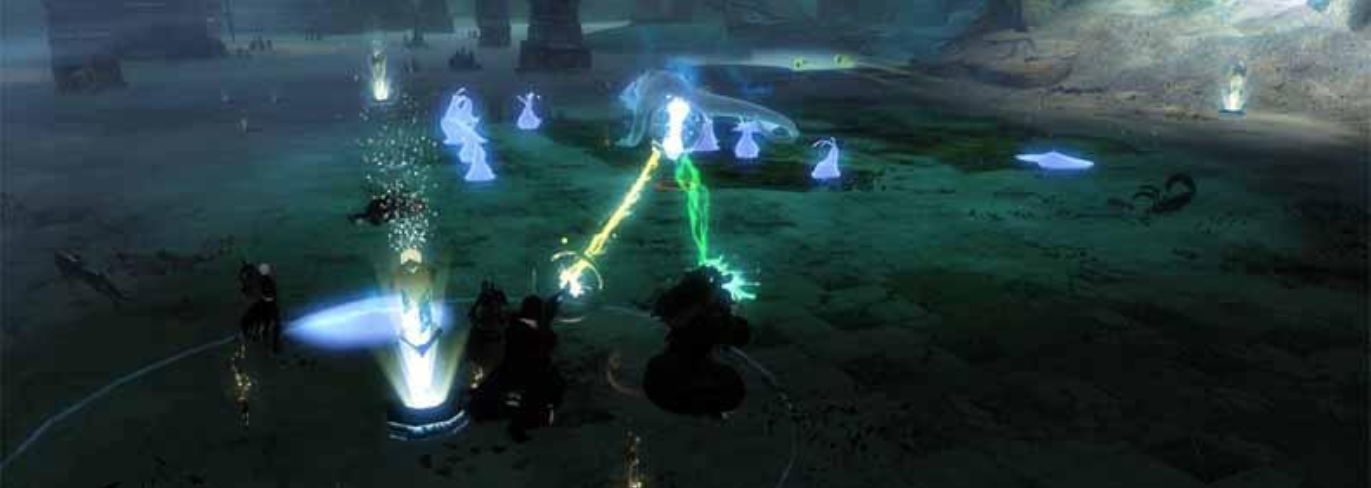
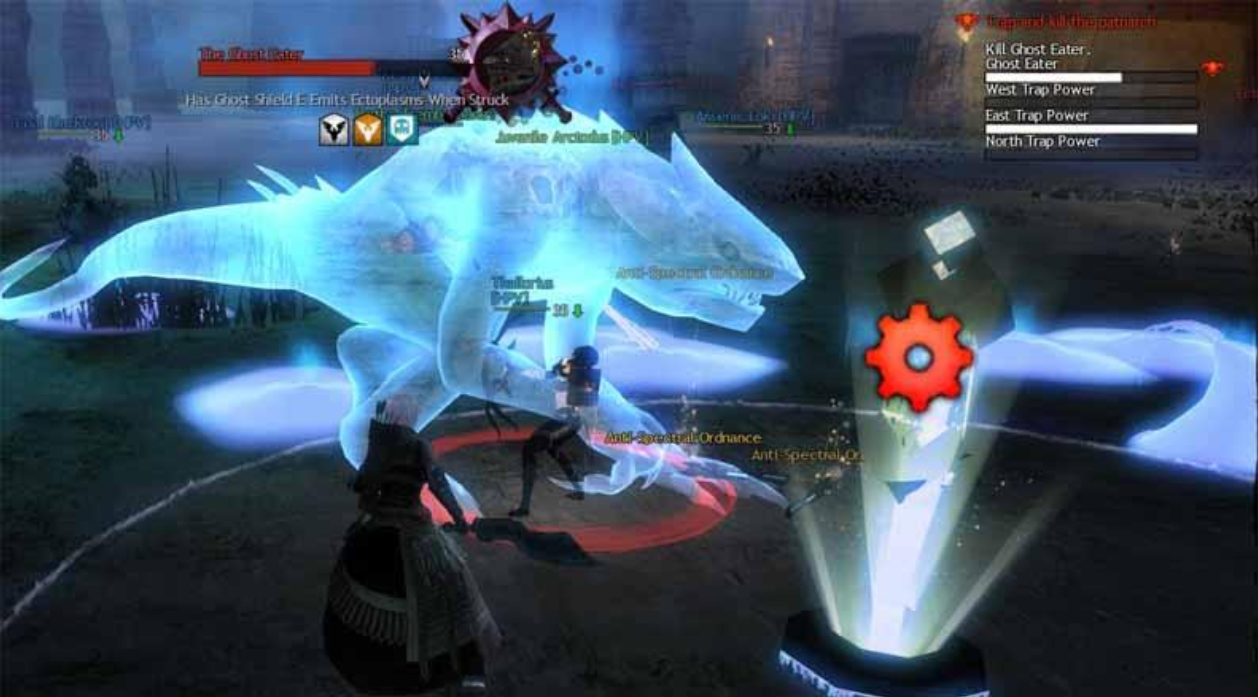
In the Ghost Eater encounter, players must defeat a boss which has a ghostly
shield that protects it from all damage and sheds Ghostly Slimes if the boss is struck by a
player. Two players must use special "Anti-Spectral Ordinance" guns to pull an
individual Ghost Slime to a device (trap) in order to charge the trap up. Once the trap is
fully charged, players have to lure the boss into the trap’s activation range, which
temporarily negates the ghostly armor of the boss, allowing Ghost Eater to be damaged
for a short time.
There are three separate traps located in the boss arena that the players can
charge. After one of the traps is used it enters a cool-down period, forcing the players to
utilize other devices in the room. Players must coordinate a tank to distract the boss while
the traps are charged by other players. Afterwards, players must focus on damaging the
boss before the ghost-shield comes back up, and they must coordinate charging another
trap. An obvious Ghost Busters theme is prevalent in the encounter.
shield that protects it from all damage and sheds Ghostly Slimes if the boss is struck by a
player. Two players must use special "Anti-Spectral Ordinance" guns to pull an
individual Ghost Slime to a device (trap) in order to charge the trap up. Once the trap is
fully charged, players have to lure the boss into the trap’s activation range, which
temporarily negates the ghostly armor of the boss, allowing Ghost Eater to be damaged
for a short time.
There are three separate traps located in the boss arena that the players can
charge. After one of the traps is used it enters a cool-down period, forcing the players to
utilize other devices in the room. Players must coordinate a tank to distract the boss while
the traps are charged by other players. Afterwards, players must focus on damaging the
boss before the ghost-shield comes back up, and they must coordinate charging another
trap. An obvious Ghost Busters theme is prevalent in the encounter.
Crucible of Eternity Level/Content Design
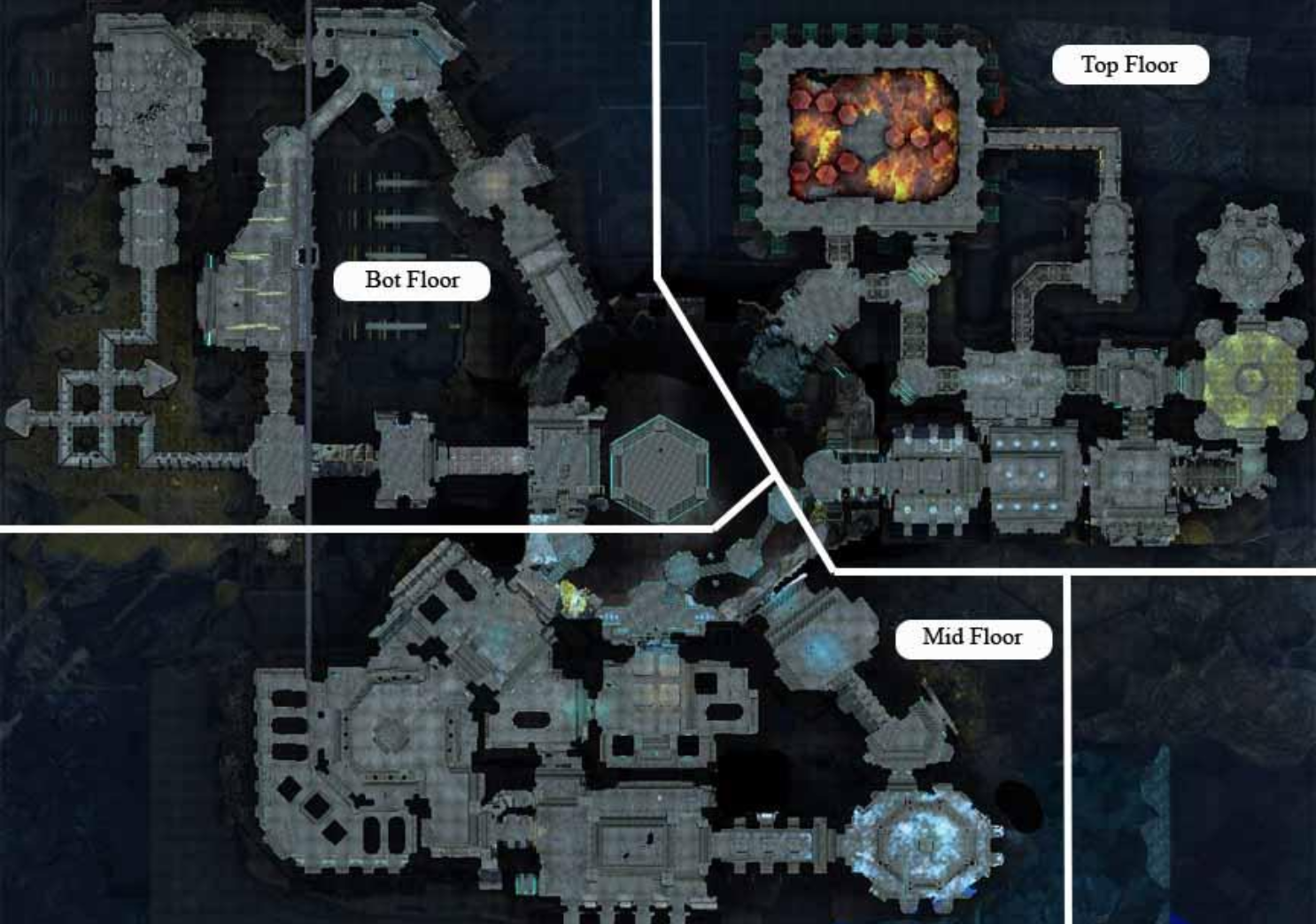
I was the sole Content Designer for both Story Mode and Explorable Mode for
Crucible of Eternity. The previous Designer had requested it to be a three floor dungeon,
but left without any work being done on it. Honoring the initial plan, I worked with the
Map Artist to rebuild the different floors, and hone the theme of an underwater science
lab. It features compartmentalized rooms and view ports to other areas.
In the Story Mode of the dungeon, players start at the top floor and work their
way down to the very bottom floor to defeat a powerful creation of the science lab. It is
the exact opposite in the Explorable Mode, where players are teleported down to the
bottom of the dungeon and must rescue an NPC when the process of shutting down the
lab inevitably goes awry.
Breaking up the sterilized grey laboratory feel is done by using different colored
lighting and set dressing, but also in defining certain areas around specific fields of study:
Destroyers (Fire), Mordremoth (Jungle), and Jormag (Ice).
Crucible of Eternity. The previous Designer had requested it to be a three floor dungeon,
but left without any work being done on it. Honoring the initial plan, I worked with the
Map Artist to rebuild the different floors, and hone the theme of an underwater science
lab. It features compartmentalized rooms and view ports to other areas.
In the Story Mode of the dungeon, players start at the top floor and work their
way down to the very bottom floor to defeat a powerful creation of the science lab. It is
the exact opposite in the Explorable Mode, where players are teleported down to the
bottom of the dungeon and must rescue an NPC when the process of shutting down the
lab inevitably goes awry.
Breaking up the sterilized grey laboratory feel is done by using different colored
lighting and set dressing, but also in defining certain areas around specific fields of study:
Destroyers (Fire), Mordremoth (Jungle), and Jormag (Ice).
Citadel of Fire: Story-Mode Content Design
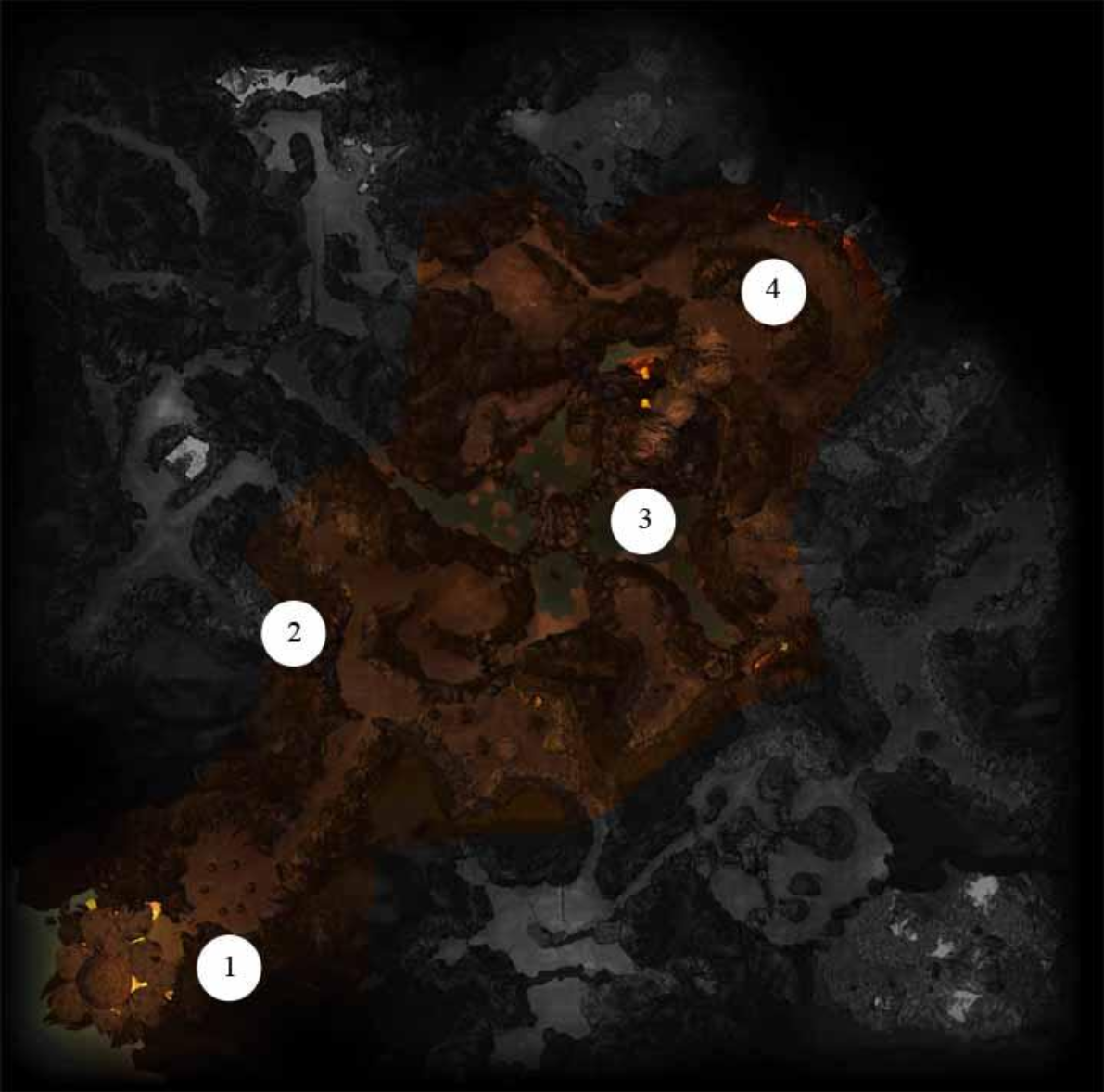
The Story Mode for Citadel of Flame features a group of five players, and two
important NPCs assaulting the home base of one of the game's enemy factions, the
Flame Legion. Story Mode dungeons are significantly easier than Explorable Mode
dungeons, and are built with a more cinematic approach with cut-scenes and dialogue
between the main NPCs and the player's character.
The players start the dungeon (1) and must fight there way through enemies I built
specifically for this dungeon, to the main chamber (2). There they must complete two
objectives by defeating mini-bosses that are specifically built to foreshadow and prepare
players for the final fight (teaching them some boss mechanics before facing the boss).
Once they get to the bridge (3), the players watch a cinematic built by the
Cinematic team, which worked with me in regards to timing and preparation. Players
then go through a few more quest-steps and mini-bosses before reaching the final boss (4)
of the dungeon.
important NPCs assaulting the home base of one of the game's enemy factions, the
Flame Legion. Story Mode dungeons are significantly easier than Explorable Mode
dungeons, and are built with a more cinematic approach with cut-scenes and dialogue
between the main NPCs and the player's character.
The players start the dungeon (1) and must fight there way through enemies I built
specifically for this dungeon, to the main chamber (2). There they must complete two
objectives by defeating mini-bosses that are specifically built to foreshadow and prepare
players for the final fight (teaching them some boss mechanics before facing the boss).
Once they get to the bridge (3), the players watch a cinematic built by the
Cinematic team, which worked with me in regards to timing and preparation. Players
then go through a few more quest-steps and mini-bosses before reaching the final boss (4)
of the dungeon.
The final boss (Baelfire) is a "giant creature" whom has unique behavior
and a different scripting technology than normal-sized NPCs. Baelfire's fight needed to
mix narrative and lore while providing a compelling encounter to a group of five players.
and a different scripting technology than normal-sized NPCs. Baelfire's fight needed to
mix narrative and lore while providing a compelling encounter to a group of five players.
Fractals of the Mist: Swamp Fractal
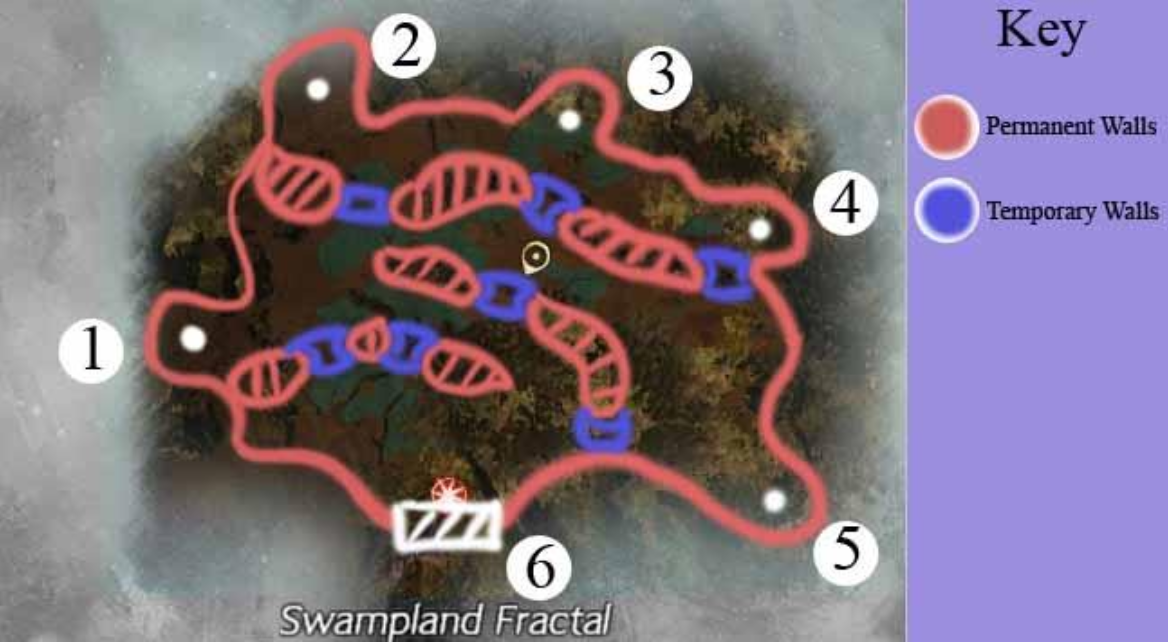
One of the levels I worked on in the Fractals of the Mist was the Swamp Fractal.
Serious space constraints meant the level design had to be a single-level and highly
compact.
The area used special trees as walls (highlighted in red) to match the theme of a
swamp. Growing and falling trees (highlighted in blue) changed periodically, adding a
level of unpredictability to the map as the players worked through the puzzle.
The content was specifically tailored around that experience, and involved a
highly coordinated item (magical orb) collection that needed to be accomplished under a
stress-inducing timer. Multiple orbs were generated (1-5 white dots), and each had a
unique challenge presented to the player that would make retrieving them more
challenging. The main objective was to split the five party members up into three smaller
groups, and force them to use teamwork and coordination while also showing an
individual mastery of their character's abilities at evasion and movement.
Three orbs would be randomly selected each time. The players would then have to
distribute party members based on overcoming each item's unique encounter. As soon as
one player picked up an orb, a timer would count down, forcing players to coordinate
being ready, and putting a heavier emphasis on preparation.
The items would have to be brought to a special receptacle (6) in order to destroy
a wall and allow progression to one of two unique bosses. If the players failed to bring
them back before the time limit, a new set of three orbs would be randomly selected, and
the players would have to try again.
While each orb had a unique encounter built for it, players also had to contend
with local wildlife, immobilizing/crippling traps, and a menacing boss creature that
would randomly ambush players carrying orbs. This forced players to memorize the static
traps, plan routes around wildlife/walls, and give the floating two players not carrying
orbs a support role to the orb-runners.
Serious space constraints meant the level design had to be a single-level and highly
compact.
The area used special trees as walls (highlighted in red) to match the theme of a
swamp. Growing and falling trees (highlighted in blue) changed periodically, adding a
level of unpredictability to the map as the players worked through the puzzle.
The content was specifically tailored around that experience, and involved a
highly coordinated item (magical orb) collection that needed to be accomplished under a
stress-inducing timer. Multiple orbs were generated (1-5 white dots), and each had a
unique challenge presented to the player that would make retrieving them more
challenging. The main objective was to split the five party members up into three smaller
groups, and force them to use teamwork and coordination while also showing an
individual mastery of their character's abilities at evasion and movement.
Three orbs would be randomly selected each time. The players would then have to
distribute party members based on overcoming each item's unique encounter. As soon as
one player picked up an orb, a timer would count down, forcing players to coordinate
being ready, and putting a heavier emphasis on preparation.
The items would have to be brought to a special receptacle (6) in order to destroy
a wall and allow progression to one of two unique bosses. If the players failed to bring
them back before the time limit, a new set of three orbs would be randomly selected, and
the players would have to try again.
While each orb had a unique encounter built for it, players also had to contend
with local wildlife, immobilizing/crippling traps, and a menacing boss creature that
would randomly ambush players carrying orbs. This forced players to memorize the static
traps, plan routes around wildlife/walls, and give the floating two players not carrying
orbs a support role to the orb-runners.